
Skip to content
Independent, research-backed kitchen gear advice. Never pay-for-placement.
Kitchen Gear Lab
Updated September 2026

The Best Espresso Machines

Nine machines that earned their place in independent tests, from a first cheap step to a brass-boiler workhorse, sorted by what you actually need on the counter.

By The Kitchen Gear Lab Test Desk · Compared from published tests, official specifications and owner feedback

Disclosure: The Kitchen Gear Lab is reader-supported. When you buy through links on our site we may earn an affiliate commission, at no extra cost to you. Picks come from cited independent tests, official specifications and owner feedback; we do not run an in-house lab and rankings are never paid for. How this works.

Top pick: Breville Barista ExpressCNET's best overall and a Tom's Guide Editor's Choice. Grinder, PID and pressure gauge in one box, so it makes good espresso on day one.

Check Price on Amazon
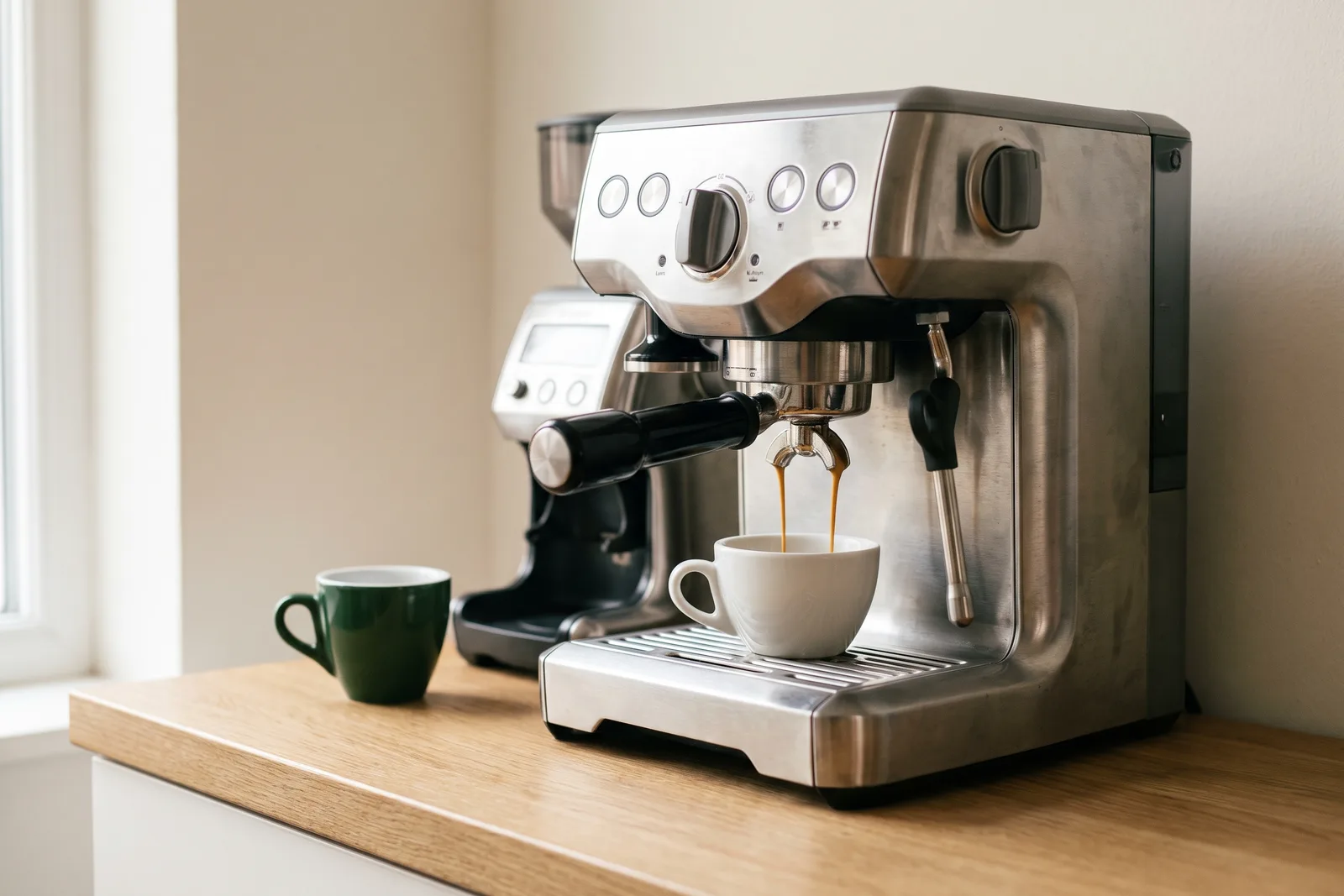
A stainless steel home espresso machine pulling a double shot into a white cup on a light oak counter.

A good home espresso machine holds a steady temperature, pushes water at about nine bar and lets you steam milk without a fight. Most of the machines that win independent tests are semi-automatics: you grind, tamp and start the shot, and the machine does the rest.

We did not run our own lab. We read the published tests from CNET, Wirecutter, Serious Eats and Tom's Guide, then checked every spec against the maker's own page. Each pro and con below is tied to one of those sources.

Start with one question: do you already own a grinder? If not, an all-in-one like the Breville Barista Express saves money and counter space. If you do, or you plan to buy a good one, a standalone machine like the Gaggia Classic Evo Pro will make better espresso for the same total spend.

Top picks at a glance

Short on time? These three cover most kitchens. Full reviews are below.

Best Overall#1

Breville Barista Express

CNET's best overall and a Tom's Guide Editor's Choice. Grinder, PID and pressure gauge in one box, so it makes good espresso on day one.

$$$

Best Value#2

Gaggia Classic Evo Pro

Wirecutter's budget pick with a 58 mm commercial group and the deepest upgrade path in home espresso. Bring your own grinder.

$$$

Best for Beginners#3

Breville Bambino Plus

Three-second heat-up and an automatic steam wand that makes latte-ready milk. The easiest real espresso you can buy.

$$$

Compare all 9 picks

Key specs side by side. Tap a name to jump to its review.

#1Editor's Choice

Breville Barista Express

Type
Semi-automatic with built-in conical burr grinder
Boiler
Thermocoil with PID temperature control
Pump pressure
15 bar pump, low-pressure pre-infusion, brews at 9 bar
Portafilter
54 mm stainless steel
Steam wand
Manual swivel wand, single-hole tip
Price
$$$
#2Best Value

Gaggia Classic Evo Pro

Type
Semi-automatic, single boiler
Boiler
Small single boiler (brass on the E24 revision), no PID
Pump pressure
15 bar Ulka pump, limited to 9 bar by the over-pressure valve
Portafilter
58 mm commercial standard
Steam wand
Commercial two-hole wand
Price
$$$
#3Best for Beginners

Breville Bambino Plus

Type
Semi-automatic, compact
Boiler
ThermoJet heater, ready in about 3 seconds, PID
Pump pressure
15 bar pump, low-pressure pre-infusion, brews at 9 bar
Portafilter
54 mm stainless steel
Steam wand
Automatic milk texturing with manual override
Price
$$$
#4Upgrade Pick

Breville Barista Pro

Type
Semi-automatic with built-in conical burr grinder
Boiler
ThermoJet heater, ready in about 3 seconds, PID
Pump pressure
15 bar pump, low-pressure pre-infusion, brews at 9 bar
Portafilter
54 mm stainless steel
Steam wand
Manual wand, faster steam than the Express
Price
$$$$
#5Best Prosumer

Rancilio Silvia

Type
Semi-automatic, single boiler, prosumer build
Boiler
Brass single boiler, no PID from the factory
Pump pressure
Vibration pump, factory set near 9 bar
Portafilter
58 mm commercial, heavy brass group
Steam wand
Articulating commercial wand, strong steam
Price
$$$$
#6Best Compact

Breville Bambino

Type
Semi-automatic, compact
Boiler
ThermoJet heater, ready in about 3 seconds, PID
Pump pressure
15 bar pump, low-pressure pre-infusion, brews at 9 bar
Portafilter
54 mm stainless steel
Steam wand
Manual wand
Price
$$
#7Best Slim

De'Longhi Dedica Arte

Type
Semi-automatic, slim body
Boiler
Thermoblock, three temperature settings
Pump pressure
15 bar pump
Portafilter
51 mm, pressurized and unpressurized baskets available
Steam wand
Manual My LatteArt wand
Price
$$
#8Best Budget

De'Longhi Stilosa

Type
Semi-automatic, entry level
Boiler
Stainless steel boiler, no PID
Pump pressure
15 bar pump
Portafilter
51 mm with pressurized baskets
Steam wand
Manual panarello wand
Price
$
#9Best Cheap Steam Wand

Casabrews 3700 Essential

Type
Semi-automatic, entry level
Boiler
Thermoblock, no PID
Pump pressure
20 bar pump (marketing figure); brews far lower
Portafilter
51 mm with pressurized baskets
Steam wand
Manual wand
Price
$

The 9 best, reviewed

Editorial selection

$$$

CNET's best overall and a Tom's Guide Editor's Choice. Grinder, PID and pressure gauge in one box, so it makes good espresso on day one.

Type
Semi-automatic with built-in conical burr grinder
Boiler
Thermocoil with PID temperature control
Pump pressure
15 bar pump, low-pressure pre-infusion, brews at 9 bar
Portafilter
54 mm stainless steel
Steam wand
Manual swivel wand, single-hole tip
Footprint
About 13 x 15 x 16 in., 24 lb

Best for: Anyone who wants espresso, a grinder and a steam wand in one box and does not own a grinder yet.

Skip it if: You already own a good grinder or plan to upgrade the machine within a few years.

Specifications and evidence: CNET — The Best Espresso Machines After Testing More Than 20 Models (updated June 2026), Tom's Guide — Breville Barista Express review (Editor's Choice), Wirecutter — The Best Home Espresso Machine, Home-Barista forum — Barista Express built-in grinder discussion, Breville — Barista Express BES870 product and spec page

Pros

  • CNET's best espresso machine overall: it ticks the most boxes of any machine they tested.
  • Tom's Guide Editor's Choice for espresso quality and easy milk steaming.
  • Grinder, tamper, dose trimmer, milk jug and cleaning kit all come in the box.
  • PID-controlled heater and a front pressure gauge make dialing in easier for beginners.

Cons

  • Wirecutter calls the built-in grinder merely adequate; Home-Barista owners say it is the first thing they outgrow.
  • 54 mm portafilter limits your choice of aftermarket baskets and tools.
  • Bulky: needs clearance above the bean hopper (CNET).

Editorial selection

$$$

Wirecutter's budget pick with a 58 mm commercial group and the deepest upgrade path in home espresso. Bring your own grinder.

Type
Semi-automatic, single boiler
Boiler
Small single boiler (brass on the E24 revision), no PID
Pump pressure
15 bar Ulka pump, limited to 9 bar by the over-pressure valve
Portafilter
58 mm commercial standard
Steam wand
Commercial two-hole wand
Footprint
About 8 x 9.5 x 14 in., 19 to 20 lb

Best for: Cooks who already own or will buy a real grinder and want the highest espresso ceiling in this tier.

Skip it if: You want a machine that is good on day one without learning or modding.

Specifications and evidence: Wirecutter — Gaggia Classic Evo Pro Review, Serious Eats — The Best Espresso Machines, Tested & Reviewed, Tom's Guide — Gaggia Classic E24 Evo Pro review, Gaggia North America — Classic Evo Pro product and spec page

Pros

  • Wirecutter's budget pick and a Serious Eats favorite for tinkerers; shots matched machines several times the price.
  • 58 mm commercial group takes any pro basket or bottomless portafilter.
  • The strongest steam wand in this tier; Tom's Guide called it vastly better than Breville's thermoblock machines.
  • Decades of parts, mods and repair documentation; the Gaggiuino community keeps it current.

Cons

  • No PID: you temperature-surf or buy a kit (Serious Eats, Home-Barista).
  • No grinder, no gauge, and the included tamper is plastic.
  • Single boiler means a wait between shot and steam (Serious Eats).
03
Best for Beginners

Breville Bambino Plus

Editorial selection

$$$

Three-second heat-up and an automatic steam wand that makes latte-ready milk. The easiest real espresso you can buy.

Type
Semi-automatic, compact
Boiler
ThermoJet heater, ready in about 3 seconds, PID
Pump pressure
15 bar pump, low-pressure pre-infusion, brews at 9 bar
Portafilter
54 mm stainless steel
Steam wand
Automatic milk texturing with manual override
Footprint
About 7.7 x 12.6 x 12.2 in., 10.8 lb

Best for: Small kitchens and latte drinkers who want fast, easy milk drinks with a good grinder beside it.

Skip it if: You pull many shots in a row or want to upgrade parts later.

Specifications and evidence: Tom's Guide — Breville Bambino Plus review, Serious Eats — The Best Espresso Machines, Tested & Reviewed, Wirecutter — The Best Home Espresso Machine, Breville — Bambino Plus BES500 product and spec page

Pros

  • Heats in about three seconds, so there is no warm-up ritual (Breville, Tom's Guide).
  • Automatic steam wand makes consistent microfoam for beginners, and you can steam by hand too.
  • Serious Eats and Wirecutter both recommend it as a compact beginner pick.
  • Smallest footprint of any machine here that still has a real steam wand.

Cons

  • Needs a separate grinder to make sense; pressurized baskets hide bad grinding.
  • 54 mm ecosystem and a light body that moves when you lock in the portafilter (Tom's Guide).
  • Thermojet cannot hold temperature as steadily as a boiler for back-to-back shots.

Breville · BES500BSS

Check Price on Amazon
04
Upgrade Pick

Breville Barista Pro

Editorial selection

$$$$

The Barista Express with faster heat, stronger steam and 30 grind settings. The best all-in-one if you make several lattes a day.

Type
Semi-automatic with built-in conical burr grinder
Boiler
ThermoJet heater, ready in about 3 seconds, PID
Pump pressure
15 bar pump, low-pressure pre-infusion, brews at 9 bar
Portafilter
54 mm stainless steel
Steam wand
Manual wand, faster steam than the Express
Footprint
About 13.5 x 16 x 16 in., 20 lb

Best for: All-in-one buyers who make several milk drinks a day and want less waiting.

Skip it if: You want the upgrade path of a 58 mm machine.

Specifications and evidence: TechGearLab — The Best Espresso Machine, lab tested and ranked, Tom's Guide — The best espresso machines, tested by an SCA-qualified barista panel, Breville — Barista Pro BES878 product and spec page

Pros

  • Faster heat-up and stronger steam than the Barista Express (Breville, Tom's Guide).
  • 30 grind settings versus 16 on the Express give finer control.
  • LCD with shot timer replaces the analog gauge; TechGearLab rates it among the best all-in-ones.

Cons

  • Same 54 mm ecosystem and the same grinder ceiling as the Express.
  • No pressure gauge, which some beginners miss.
  • Premium tier for an all-in-one; a Gaggia plus a good grinder costs about the same.

Breville · BES878BSS

Check Price on Amazon
05
Best Prosumer

Rancilio Silvia

Editorial selection

$$$$

Brass boiler, commercial group and a build that lasts decades. A machine to grow into, not out of.

Type
Semi-automatic, single boiler, prosumer build
Boiler
Brass single boiler, no PID from the factory
Pump pressure
Vibration pump, factory set near 9 bar
Portafilter
58 mm commercial, heavy brass group
Steam wand
Articulating commercial wand, strong steam
Footprint
About 9.2 x 11.4 x 13.4 in., 30 lb

Best for: Buyers who want a machine that will outlast several grinders and are happy to learn it.

Skip it if: You want convenience features like a gauge, auto milk or a built-in grinder.

Specifications and evidence: Tom's Guide — Rancilio Silvia V6 review, Serious Eats — The Best Semi-Automatic Espresso Machines, Rancilio — Silvia product page

Pros

  • Commercial-grade brass boiler and group; Tom's Guide praised the build and steam power.
  • Serious Eats lists it as a durable prosumer machine that lasts decades with basic care.
  • 58 mm group and a huge parts and mod ecosystem.

Cons

  • No PID means temperature surfing, just like the Gaggia (Tom's Guide).
  • Heavy, slow to reach steam temperature, and premium priced without a grinder.
  • Needs a quality grinder to justify itself.

Rancilio · Silvia M V6

Check Price on Amazon
06
Best Compact

Breville Bambino

Editorial selection

$$

Same fast heater and PID as the Plus with a manual wand and a lower tier. Pair it with a grinder and learn.

Type
Semi-automatic, compact
Boiler
ThermoJet heater, ready in about 3 seconds, PID
Pump pressure
15 bar pump, low-pressure pre-infusion, brews at 9 bar
Portafilter
54 mm stainless steel
Steam wand
Manual wand
Footprint
About 7.6 x 12.5 x 12 in., 10 lb

Best for: Beginners on a budget who already have, or will buy, a grinder.

Skip it if: You make several milk drinks in a row.

Specifications and evidence: Tom's Guide — Breville Bambino review, Breville — Bambino BES450 product and spec page, Serious Eats — The Best Espresso Machines, Tested & Reviewed

Pros

  • Same fast ThermoJet heater and PID as the Bambino Plus at a lower tier (Breville).
  • Tom's Guide praised the shot quality for the money and the tiny footprint.
  • Manual wand is a better teacher than the Plus's auto mode if you want to learn latte art.

Cons

  • Steam is weaker and slower than the Plus (Tom's Guide).
  • Plastic-heavy body; the drip tray fills fast.
  • Needs a real grinder, which adds to the true cost.

Breville · BES450BSS

Check Price on Amazon
07
Best Slim

De'Longhi Dedica Arte

Editorial selection

$$

About six inches wide. The only serious machine that fits a galley kitchen or a dorm counter.

Type
Semi-automatic, slim body
Boiler
Thermoblock, three temperature settings
Pump pressure
15 bar pump
Portafilter
51 mm, pressurized and unpressurized baskets available
Steam wand
Manual My LatteArt wand
Footprint
About 5.9 in. wide, 13 in. deep, 12 in. tall, 9 lb

Best for: Tiny kitchens and apartment counters where width is the deciding factor.

Skip it if: You want to grow into unpressurized baskets and serious dialing-in.

Specifications and evidence: Homes & Gardens — De'Longhi Dedica Arte review (qualified barista), De'Longhi — Dedica Arte EC885M product page, CNET — The Best Espresso Machines After Testing More Than 20 Models (updated June 2026)

Pros

  • Only about six inches wide; the slimmest real espresso machine you can buy (De'Longhi).
  • Homes & Gardens' barista reviewer got good shots and usable microfoam once the pressurized basket was swapped.
  • Three temperature presets and a fast thermoblock.

Cons

  • 51 mm portafilter and pressurized baskets by default limit espresso quality.
  • Small drip tray and water tank; thermoblock temperature drifts on back-to-back shots.
  • Plastic portafilter handle and a steam wand that needs the panarello sleeve removed to learn properly.

De'Longhi · EC885M

Check Price on Amazon
08
Best Budget

De'Longhi Stilosa

Editorial selection

$

Tom's Guide's pick for the cheapest machine that still makes a proper shot. Swap the basket and it gets better.

Type
Semi-automatic, entry level
Boiler
Stainless steel boiler, no PID
Pump pressure
15 bar pump
Portafilter
51 mm with pressurized baskets
Steam wand
Manual panarello wand
Footprint
About 8.1 x 13.5 x 11.2 in., 5 lb

Best for: First-time buyers who want to learn on the cheapest machine that is not a toy.

Skip it if: You care about milk texture or plan to keep the machine for years.

Specifications and evidence: Tom's Guide — De'Longhi Stilosa review, De'Longhi — Stilosa EC260BK product page

Pros

  • Tom's Guide calls it the best cheap espresso machine that still makes a proper shot.
  • Real steam wand and a stainless boiler at the lowest tier here.
  • Light and simple: two buttons and a dial.

Cons

  • Pressurized baskets fake crema; you need an aftermarket basket for real espresso (Tom's Guide).
  • Weak, slow steam and a wobbly plastic body.
  • No temperature control; shots run hot after steaming.

De'Longhi · EC260BK

Check Price on Amazon
09
Best Cheap Steam Wand

Casabrews 3700 Essential

Editorial selection

$

Punches above its tier on crema and steam. A first machine for a first apartment.

Type
Semi-automatic, entry level
Boiler
Thermoblock, no PID
Pump pressure
20 bar pump (marketing figure); brews far lower
Portafilter
51 mm with pressurized baskets
Steam wand
Manual wand
Footprint
About 5.5 x 12.3 x 12 in., 9.5 lb

Best for: Students and first apartments where the whole setup must stay cheap.

Skip it if: You want a machine you can grow with.

Specifications and evidence: Tom's Guide — Casabrews 3700 Essential review, Casabrews — 3700 Essential product page

Pros

  • Tom's Guide found it punches above its tier on crema and steam for the money.
  • Slim stainless body, big removable tank and a real steam wand.
  • Amazon's best-selling budget machine, so parts and baskets are easy to find.

Cons

  • No temperature control and a thermoblock that swings between shots.
  • Pressurized baskets only in the box; the 20 bar claim is marketing.
  • Short track record versus De'Longhi or Breville for long-term reliability.

Casabrews · 3700 Essential

Check Price on Amazon

How we chose

Independent test results

Every machine here was tested or recommended by CNET, Wirecutter, Serious Eats or Tom's Guide. Amazon-only brands with no outside testing did not make the cut.

Temperature stability

Espresso wants water near 200 degrees F. Machines with a PID or a properly sized boiler hold that; cheap thermoblocks swing. We say which is which and what that costs you.

Real brew pressure

Good espresso is pulled at about nine bar, the figure the Specialty Coffee Association uses. A 15 or 20 bar pump rating is a marketing number, not a brew pressure.

Portafilter and baskets

58 mm is the commercial standard and opens up every accessory. 54 mm is Breville's ecosystem. 51 mm machines usually ship with pressurized baskets that fake crema.

Steam wand quality

Milk drinks are why most people buy an espresso machine. We weighed steam power, recovery time and whether the wand teaches you or hides mistakes.

Grinder reality

The grinder matters as much as the machine. All-in-ones save money up front; standalone machines assume you will spend on a burr grinder and reward you for it.

How to choose an espresso machine

Semi-automatic, super-automatic or manual? Semi-automatic machines are what every pick here is: you grind, dose, tamp and press a button. They make the best espresso for the money and are what CNET, Wirecutter and Serious Eats recommend for home. Super-automatics grind and brew at one touch but cost more for worse espresso. Manual lever machines are for hobbyists.

Single boiler, dual boiler or thermoblock? A single boiler (Gaggia, Rancilio) makes rich espresso but needs a pause to switch to steam. A thermoblock or thermocoil (Breville, De'Longhi) heats water on demand, so it is fast and switches to steam almost instantly, at some cost to stability. Dual boilers do both at once but start well above the tiers in this guide.

Ignore the bar count. Espresso is brewed at about nine bar. A 15 or 20 bar pump only means the pump can push harder than needed; better machines use an over-pressure valve to hold nine. Look for a PID or a brass boiler instead, because temperature is what actually changes the taste.

54 mm or 58 mm? Breville uses 54 mm baskets, which work fine but limit you to Breville-compatible accessories. 58 mm is the commercial standard: any precision basket, bottomless portafilter or tamper fits. If you think you will get serious, 58 mm is the safer buy.

The grinder matters more than the machine. Wirecutter, Serious Eats and every barista forum say the same thing. An all-in-one gets you started, but its grinder is the ceiling. A standalone machine plus a good burr grinder makes better espresso for the same total, so decide up front which path you are on.

Steam wand quality decides your lattes. A commercial two-hole wand (Gaggia, Rancilio) is powerful but needs a learning curve. Breville's single-hole wands are slower and more forgiving. Automatic wands (Bambino Plus) make good foam every time but teach you nothing.

Counter space and what each tier buys. Slim machines like the Dedica are about six inches wide; all-in-ones with a hopper need a foot of width and room above. At the lowest tier you get a real shot with pressurized baskets. The middle tier adds PID, better steam and unpressurized baskets. The top tier here buys build quality and an upgrade path, not necessarily better espresso on day one.

Frequently asked questions

What is the best espresso machine for a beginner?

The Breville Bambino Plus for most beginners. Its automatic steam wand and three-second heat-up remove the two things new users struggle with. If you want a grinder included, the Breville Barista Express is CNET's best overall and adds a pressure gauge that shows you when the shot is right.

Source: CNET — The Best Espresso Machines (updated June 2026), Tom's Guide — The best espresso machines, tested by an SCA-qualified barista panel

Do I really need a separate grinder?

Yes, unless you buy an all-in-one. Pre-ground coffee goes stale within hours and cannot be dialed in. Wirecutter and Serious Eats both say the grinder matters as much as the machine. Budget for a burr grinder with espresso-fine settings, or buy a machine with one built in.

Source: Wirecutter — The Best Home Espresso Machine, Serious Eats — The Best Espresso Machines, Tested & Reviewed

Is 15 bar or 20 bar better?

Neither number matters. Espresso is brewed at about nine bar, the Specialty Coffee Association standard, and good machines use an over-pressure valve to hold it there. Pump ratings are a marketing figure. Look for temperature control instead.

Source: Specialty Coffee Association — Espresso brewing standards, Gaggia North America — Classic Evo Pro spec page

Is the Breville Barista Express still worth it?

For most people, yes. CNET named it best overall in 2026 and Tom's Guide gave it an Editor's Choice. Its limit is the built-in grinder, which Wirecutter calls adequate. If you already own a good grinder, the Gaggia Classic Evo Pro makes better espresso for similar money.

Source: CNET — The Best Espresso Machines (updated June 2026), Wirecutter — The Best Home Espresso Machine, Breville — Barista Express BES870 spec page

What does PID mean on an espresso machine?

A PID is a controller that holds the brew water at a set temperature instead of letting a thermostat swing it up and down. Breville's Barista and Bambino machines have one; the Gaggia Classic and Rancilio Silvia do not, which is why owners temperature-surf or fit a kit.

Source: Breville — Barista Express BES870 spec page, Gaggia North America — Classic Evo Pro spec page

How long does an espresso machine last?

A well-built single-boiler machine like the Rancilio Silvia or Gaggia Classic can run for decades with descaling and basic parts, which is why Serious Eats recommends them for long-term owners. Thermoblock all-in-ones typically see five to ten years of daily use before the grinder or pump needs attention.

Source: Serious Eats — The Best Espresso Machines, Tested & Reviewed

Can I make lattes with a cheap espresso machine?

Yes. Even the De'Longhi Stilosa and Casabrews 3700 have a steam wand, and Tom's Guide got usable foam from both. The difference at higher tiers is steam power and recovery time, so you wait less and get finer microfoam.

Source: Tom's Guide — The best espresso machines, tested by an SCA-qualified barista panel

Which espresso machine has the best steam wand?

In this guide, the Gaggia Classic Evo Pro and Rancilio Silvia. Both use commercial two-hole wands; Tom's Guide called the Gaggia's vastly better than Breville's thermoblock machines. For hands-off milk, the Bambino Plus's automatic wand is the easiest.

Source: Tom's Guide — The best espresso machines, tested by an SCA-qualified barista panel, Gaggia North America — Classic Evo Pro spec page

The bottom line

Buy the Barista Express if you have no grinder, the Gaggia Classic Evo Pro if you do, and the Bambino Plus if easy milk drinks matter more than tinkering. Browse all our best-of guides to see how it fits into a full kitchen.

Keep reading