
Gaggia Classic E24 Review [2026]

By Marvin Smit
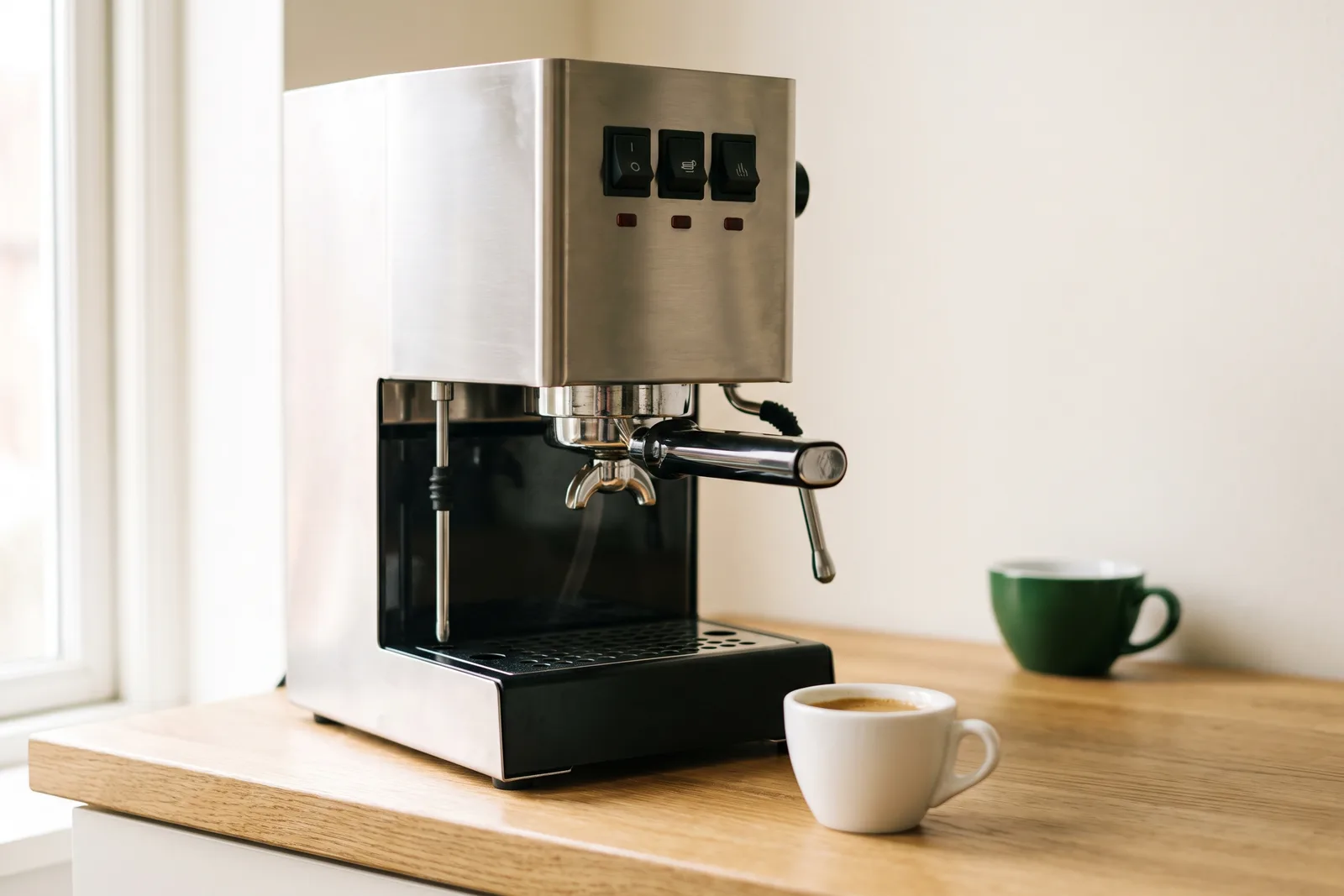
Gaggia RI9380/46 E24 — North American version
Disclosure: The Kitchen Gear Lab is reader-supported. When you buy through links on our site we may earn an affiliate commission, at no extra cost to you. Picks come from cited independent tests, official specifications and owner feedback; we do not run an in-house lab and rankings are never paid for. How this works.
Quick verdict
Choose the Classic E24 if you want a separate machine and grinder, enjoy preparing each shot, and are happy to steam milk by hand. Its brass boiler is the key distinction from older Evo Pro versions. For automatic milk or a grinder in the same appliance, compare the Bambino Plus or Barista Express.
Buy it if: Owners choosing a separate espresso setup and manual milk preparation.
Skip it if: You want automatic milk or an integrated grinder.
Pros
- Gaggia specifies a brass boiler for the E24 revision.
- Separate machine and grinder let you choose each component independently.
- Manual brew and steam controls suit owners who want a hands-on routine.
Cons
- Budget separately for grinding if you want to dial in whole beans.
- One boiler serves brewing and steaming, so drinks require a sequence of steps.
- Check the selected listing: older Evo Pro descriptions may still appear.
Key specifications
- Type
- Semi-automatic, single boiler
- Boiler
- Brass, E24 revision
- Pump pressure
- 9-bar OPV; 15-bar pump (North America)
- Portafilter
- 58 mm; verify accessory fit
- Steam wand
- Manual, two-hole tip
- Footprint
- 8 × 9.5 × 14.2 in. (W × D × H), per Gaggia NA
- Built-in grinder
- No
- PID
- No factory PID
Sources: Gaggia North America — Classic Pro E24 specifications, Gaggia — Classic E24, Gaggia — Classic E24 US operating manual, Whole Latte Love — North American Evo Pro launch, 2023, Whole Latte Love — Lined versus unlined boilers
E24 vs Evo Pro: what are you buying?
This review now focuses on the Classic E24 sold in North America. Gaggia identifies its boiler as brass. Older Classic Pro and Evo Pro names still appear in listings and reviews, so check the selected version before buying. A familiar stainless case does not establish which boiler is inside.
The North American Evo Pro launch in 2023 introduced a coated boiler and a revised pressure valve. Whole Latte Love later documented a change to unlined boilers in some Evo machines. That means “Evo Pro” alone does not establish the coating or replacement history of a used machine.
If you are buying new and specifically want the brass boiler, ask for an E24 listing with that specification. For used or refurbished stock, request the model label and service history. A replacement boiler can make the original model name an incomplete description.
Is the E24 worth choosing over an older Classic?
For a new purchase, our preference is an explicitly identified E24 when the total setup cost fits your budget. The reason is clarity about the boiler revision, rather than a promise of better espresso from every shot.
An older Evo Pro can still be worth considering if its condition, boiler history and seller support are clear. Compare the complete offer: machine, needed accessories, grinder and any immediate service. A low machine-only price can hide work you did not plan to do.
Already own a working Classic? The E24 name alone is not a reason to replace it. Identify what you want to improve: adjustment at the grinder, the milk routine, temperature control or a maintenance issue. Those point to different solutions.
Brass boiler does not mean automatic temperature control
Gaggia describes the larger brass boiler as improving heat storage and stability. That is a manufacturer claim, not a measurement from our own lab. The E24 remains a machine with manual brew and steam controls; the brass revision is not a factory PID upgrade.
For daily use, learn the stock routine before shopping for modifications. Keep the dose and recipe consistent and follow the ready-light guidance in the manual. We do not prescribe a universal temperature-surfing timer or claim that every owner needs a PID kit.
A PID kit is a separate purchase and installation decision. Check support for the exact voltage, boiler and machine revision with the kit supplier. Do not choose a machine on the assumption that all Classic kits fit or that installation takes a fixed number of hours.
Espresso and milk: the daily routine
The E24 uses one boiler for brewing and steaming. You prepare the coffee, start and stop the shot, then switch to steam for milk. It suits someone who wants those tasks to be part of making coffee.
The US manual explains how to return the boiler to brewing temperature after steaming. That extra step matters when making several milk drinks in succession. Judge the workflow as a whole instead of choosing on a claimed steam speed from a different Classic generation.
We would choose the E24 for an owner who wants to learn manual milk texture. If automatic milk is the main priority, compare the Bambino Plus. If you often make several drinks together, include the transition between drinks in your decision.
For the single-wall workflow, use our step-by-step espresso dial-in guide to keep dose and yield consistent while adjusting grind.
Budget for the grinder and the complete station
There is no built-in grinder. For dialing in with a non-pressurized basket, include an espresso-capable grinder in the setup budget. If starting with pre-ground coffee, follow the instructions for the supplied pressurized filter arrangement rather than assuming all baskets work the same way.
The Encore ESP is a starting point in our grinder guide; a manual espresso grinder is another option if you accept the work. Include room for the grinder, a scale, the milk pitcher and access to the water tank when measuring your counter.
Before ordering extras, check what your seller includes. Basket diameter alone does not establish full portafilter compatibility. Choose tampers, baskets and replacement handles using the supplier’s fit information for your model.
Check the basket workflow first: our pressurized vs single-wall basket explanation shows why pre-ground and freshly ground coffee call for different setup decisions.
Who should buy it, and who should choose an alternative?
Buy the E24 if you want separate components, manual shot control and a milk routine you can learn. Our recommendation is about ownership and workflow; we have not run a head-to-head taste test or assigned a numerical performance score.
Choose the Barista Express if you want the grinder built into the appliance. Choose the Bambino Plus if automatic milk is a more useful feature than the Gaggia’s traditional controls. Both are linked below so you can compare the complete purchase.
For an older Evo Pro, confirm the actual boiler before applying E24 buying advice. This review does not treat older review awards, steam timings or modification instructions as evidence for every Classic revision.
Alternatives worth a look
Breville Bambino Plus
Small kitchens and latte drinkers who want fast, easy milk drinks with a good grinder beside it.
$$$
Breville Barista Express
Anyone who wants espresso, a grinder and a steam wand in one box and does not own a grinder yet.
$$$
Frequently asked questions
What is the main difference between the Evo Pro and E24?
The E24 is identified by its brass boiler. The Evo Pro history includes lined and unlined boilers, so confirm the exact version and any service replacements when buying older stock.
Source: Gaggia — Classic E24, Whole Latte Love — North American Evo Pro launch, 2023, Whole Latte Love — Lined versus unlined boilers
Does the Gaggia Classic E24 have a PID?
The stock E24 covered here does not include a PID temperature controller. A brass boiler is not the same feature as electronic temperature regulation. Aftermarket kits require a separate compatibility check.
Do I need a grinder for the E24?
For control with a non-pressurized basket, plan for an espresso-capable grinder. Pre-ground coffee can be a starting point with the appropriate pressurized filter arrangement described in the manual.
Does the E24 brew and steam at the same time?
No. It uses a single boiler for both jobs. Follow the manual’s transition back to brewing temperature after steaming, especially when making another drink immediately.
Do I need a 9-bar spring modification?
Do not assume so. Gaggia North America lists a 9-bar OPV for its E24. Check the actual regional version before considering a pressure modification.
Source: Gaggia North America — Classic Pro E24 specifications
Is an E24 listing the same as an older Evo Pro listing?
Not necessarily. Confirm the selected version and boiler specification with the seller. Older descriptions, photographs and reviews can remain attached to a listing after a model update.
Final recommendation
Choose the Classic E24 if you want a separate machine and grinder, enjoy preparing each shot, and are happy to steam milk by hand. Its brass boiler is the key distinction from older Evo Pro versions. For automatic milk or a grinder in the same appliance, compare the Bambino Plus or Barista Express.