Skip to content
Independent, research-backed kitchen gear advice. Never pay-for-placement.
Kitchen Gear Lab
Updated September 2026

Baratza Encore vs Encore ESP

By The Kitchen Gear Lab Test Desk

Disclosure: The Kitchen Gear Lab is reader-supported. When you buy through links on our site we may earn an affiliate commission, at no extra cost to you. Picks come from cited independent tests, official specifications and owner feedback; we do not run an in-house lab and rankings are never paid for. How this works.
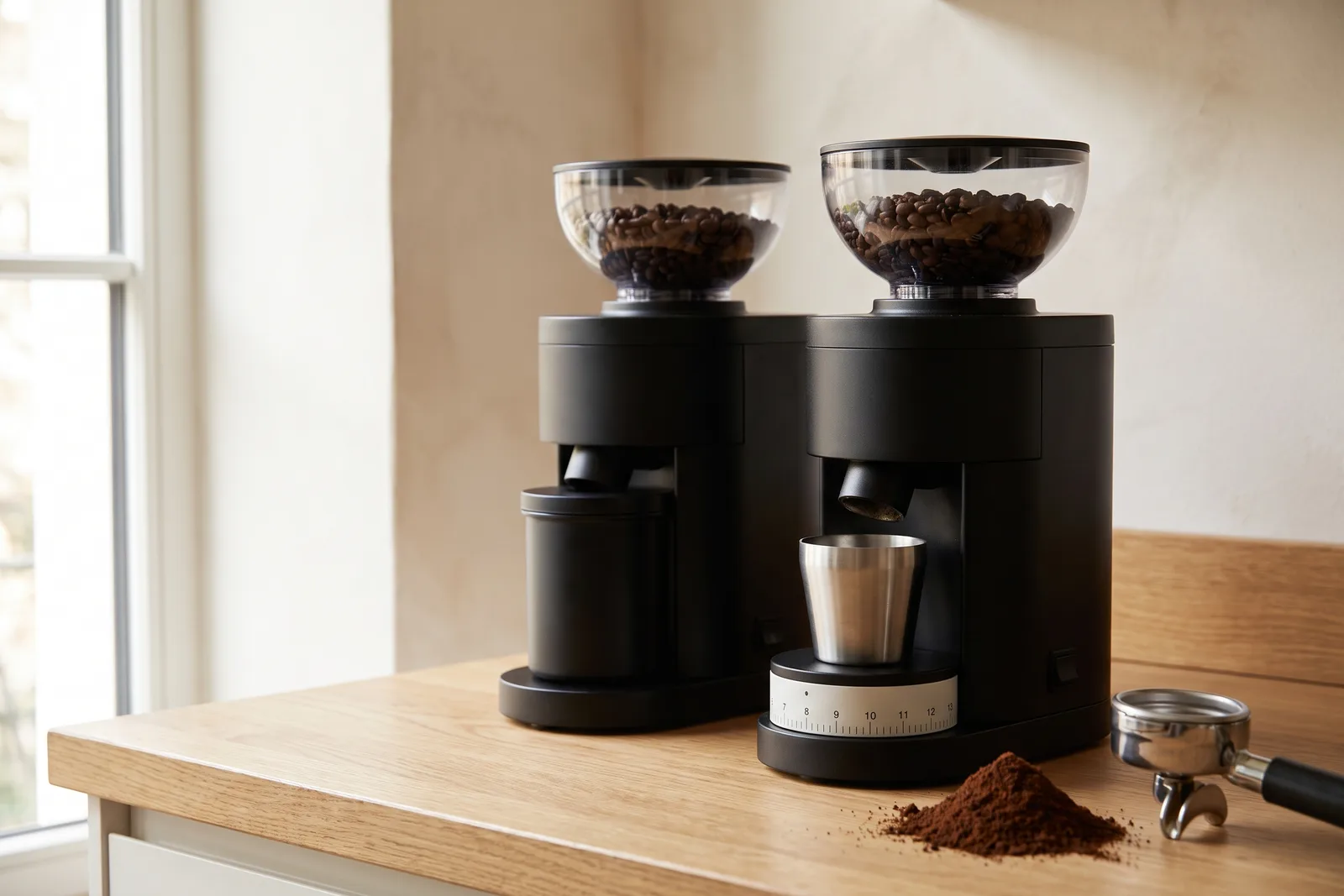
Two matte black Baratza Encore grinders side by side on a wooden counter, the ESP with its dosing cup and numbered ring, with espresso grounds and a portafilter in front.

The short answer

Baratza Encore ESP wins. Buy the Encore ESP unless you are certain you will never make espresso. It is the same grinder as the Encore, same 40 mm steel burrs, same motor, same repairable body, with the fine half of the dial reworked into 20 micro-steps and a dosing cup in the box. Tom's Guide calls it the perfect first grinder and Wirecutter picks it as the entry espresso grinder. The standard Encore is the right buy only if you brew drip, pour-over or French press exclusively and want to save a little.

Runner-up

Baratza Encore

Drip, pour-over, AeroPress and French press households with no espresso plans.

$$

Our pick

Baratza Encore ESP

Anyone pairing a Gaggia, Bambino or Barista-class machine with their first real espresso grinder.

$$

Side by side

SpecBaratza EncoreBaratza Encore ESP
Burrs and motor40 mm M2 steel conical burrs, 550 rpm DC motorSame 40 mm steel conical burrs and motor (Tom's Guide confirms the ESP line shares them)
Adjustment40 stepped settings from fine drip to French press40 settings: 1 to 20 are espresso micro-steps, 21 to 40 are regular filter steps
Espresso-capableOnly with pressurized baskets (Baratza)Yes, with single-wall baskets; Tom's Guide dialed in espresso on it
Filter and French pressFull range in even steps; the better drip grinderCoarse range compressed into 20 wider steps; Tom's Guide found setting 30 scattered from espresso-fine to coarser than French press
In the boxGrounds bin, brushGrounds bin, 54 mm dosing cup, silicone mat, brush
Hopper and single dosingAbout 8 oz hopperAbout 10 oz hopper; Tom's Guide advises staying under about 100 g to limit retention
Noise and speedLoud; a full hopper takes about a minute82 dB and 1 minute 6 seconds for 150 g in Tom's Guide's test
RetentionAbout a gram in typical use0.6 g at an 18 g dose, 2.1 g with a full hopper (Tom's Guide)
RepairabilityEvery part sold by Baratza; out-of-warranty repairsSame; Tom's Guide praises the parts catalogue down to the 58 mm dosing cup

Key differences

The Encore and the Encore ESP are the same machine underneath. Both use Baratza's 40 mm hardened steel conical burrs and the same 550 rpm gear-reduced motor, the same plastic body, the same one-button operation and the same lift-out upper burr. Tom's Guide's review of the newer ESP Pro confirms the ESP line still runs the original 40 mm burrs.

What Baratza changed on the ESP is the adjustment ring and the accessories. The 40 settings are split: 1 to 20 are micro-steps in the espresso range, 21 to 40 are regular steps for filter brewing. Tom's Guide describes exactly that in testing: incremental differences from 0 to 20, then an instantly visible jump at 21. The ESP also ships with a 54 mm dosing cup that sits under the chute so you can grind straight into a portafilter, and a silicone mat.

On the standard Encore the 40 steps spread evenly from fine drip to coarse French press, which makes it the more natural filter grinder, but Baratza's own page says it only handles espresso with pressurized baskets. That is the whole decision: do you need the fine half of the dial or the coarse half?

Espresso

The ESP can do it, the Encore cannot. Tom's Guide struggled to get a truly fine grind at settings 0 and 1 on the ESP, so it is not a Turkish grinder, but the micro-steps between 1 and 20 are what let you land a 25 to 30 second shot on a single-wall basket. Its sieve test showed about half the finest-setting grounds under 500 microns and nearly all under 800, which is workable espresso on an entry machine.

The Encore's finest setting is roughly where the ESP's setting 20 sits, so on a Bambino Plus or Gaggia Classic Evo Pro with a single-wall basket the shot runs through in well under 20 seconds. Tom's Guide saw the same failure mode with Breville's Dose Control Pro on the Bambino Plus. With dual-wall baskets the Encore makes drinkable espresso because the basket creates the pressure, but you are not really dialing in.

Neither grinder is a serious espresso grinder. Tom's Guide found the ESP's grind less uniform than a Comandante C40 and would send coffee nerds to a hand grinder or a flat-burr machine. For a first espresso setup the ESP is enough, and it is the grinder Wirecutter and our best espresso machine guide pair with beginner machines.

Drip, pour-over and French press

Here the standard Encore is the better tool, and it is why our coffee grinder guide ranks it the best grinder for drip. Its 40 steps spread evenly across the filter range, so a pour-over setting and a French press setting are many clicks apart and easy to return to.

The ESP compresses that whole range into steps 21 to 40, and the jumps are wider. Tom's Guide's sieve results show setting 30 scattering from espresso-fine to coarser than French press, and setting 40 with 40 percent of grounds above 1100 microns. For daily pour-over you will find a setting that works, but you have fewer choices and a less tidy distribution than on the Encore at the same coarseness.

If you only brew filter coffee and never plan on espresso, the Encore is the right buy. If you brew both, the ESP's filter range is a compromise you can live with, and its espresso range is something the Encore simply does not have.

Price and value

The ESP sits a small step above the Encore in the same tier. For the difference you get the micro-step ring, the dosing cup and the mat, and you keep everything that makes the Encore a safe buy: the parts catalogue, the repair service and the ten-plus years of Wirecutter recommendations behind the design.

The newer Encore ESP Pro adds a digital readout, a light and anti-static ion generation for a tier more, and Tom's Guide's advice is to skip it and buy the ESP, since both use the same burrs and give similar results. That makes the ESP the value pick of the three.

Who should buy which

Buy the Encore if you brew drip, pour-over, AeroPress or French press, you have no espresso machine and no plan to get one, and you want the most even filter range in the tier. It is the grinder Wirecutter has recommended for over a decade and the one our Baratza Encore review covers in depth.

Buy the Encore ESP if you own or will own an espresso machine, or if you are not sure. Tom's Guide calls it the perfect first grinder with no learning curve, and the dosing cup makes it a natural partner for a Bambino Plus, a Barista-class machine used with an external grinder, or a Gaggia. Keep the hopper under about 100 grams to keep retention low.

If you already own an Encore and want espresso, check Baratza's parts store: the ESP adjustment assembly is sold separately, and because the two grinders share every other part the swap is a screwdriver job. Confirm it fits your Encore's generation before ordering.

Frequently asked questions

What is the difference between the Baratza Encore and the Encore ESP?

Same burrs, motor and body. The ESP replaces the adjustment ring so settings 1 to 20 are espresso micro-steps and 21 to 40 are filter steps, and it adds a 54 mm dosing cup and silicone mat. The standard Encore spreads its 40 steps evenly across the filter range and cannot grind fine enough for unpressurized espresso.

Source: Baratza — Encore ESP product page, Baratza — Encore product page, Tom's Guide — Baratza Encore ESP review (Erin Bashford, Recommended)

Can the Encore ESP really grind for espresso?

Yes, for an entry machine. Tom's Guide dialed it in and found the micro-steps between 0 and 20 make small, usable changes, though it could not get a Turkish-fine grind and the distribution is less uniform than a Comandante. Wirecutter picks it as the entry espresso grinder.

Source: Tom's Guide — Baratza Encore ESP review (Erin Bashford, Recommended), Wirecutter — The Best Coffee Grinder

Is the standard Encore better for pour-over?

Slightly, yes. Its 40 steps cover only the filter range, so settings are closer together and easier to fine-tune. Tom's Guide's sieve test of the ESP showed wide, scattered jumps in the coarse settings above 20. Both make good filter coffee; the Encore gives you more choices there.

Source: Tom's Guide — Baratza Encore ESP review (Erin Bashford, Recommended), Baratza — Encore product page

How loud and how fast are they?

Both are loud for their size. Tom's Guide measured the ESP at 82 dB and timed a full 150 g hopper at 1 minute 6 seconds; the Encore uses the same 550 rpm motor and is comparable. A single 18 g espresso dose takes well under 20 seconds.

Source: Tom's Guide — Baratza Encore ESP review (Erin Bashford, Recommended), Tom's Guide — Baratza Encore ESP Pro review

Can I upgrade an Encore to an ESP?

Usually. Baratza sells the ESP adjustment assembly as a part, and the two grinders share burrs, motor and body, so the swap is a few minutes with a screwdriver. Check compatibility with your Encore's generation on Baratza's site first; it is cheaper than buying a second grinder.

Source: Baratza — Encore ESP product page, Tom's Guide — Baratza Encore ESP review (Erin Bashford, Recommended)

Should I get the Encore ESP Pro instead?

Probably not. Tom's Guide found the ESP Pro uses the same 40 mm burrs and delivers similar results for a tier more, and recommends the standard ESP unless you want its digital display and anti-static feature.

Source: Tom's Guide — Baratza Encore ESP Pro review

Keep reading